GloboPoll blog · News
Nine poll types: which one to use, and when
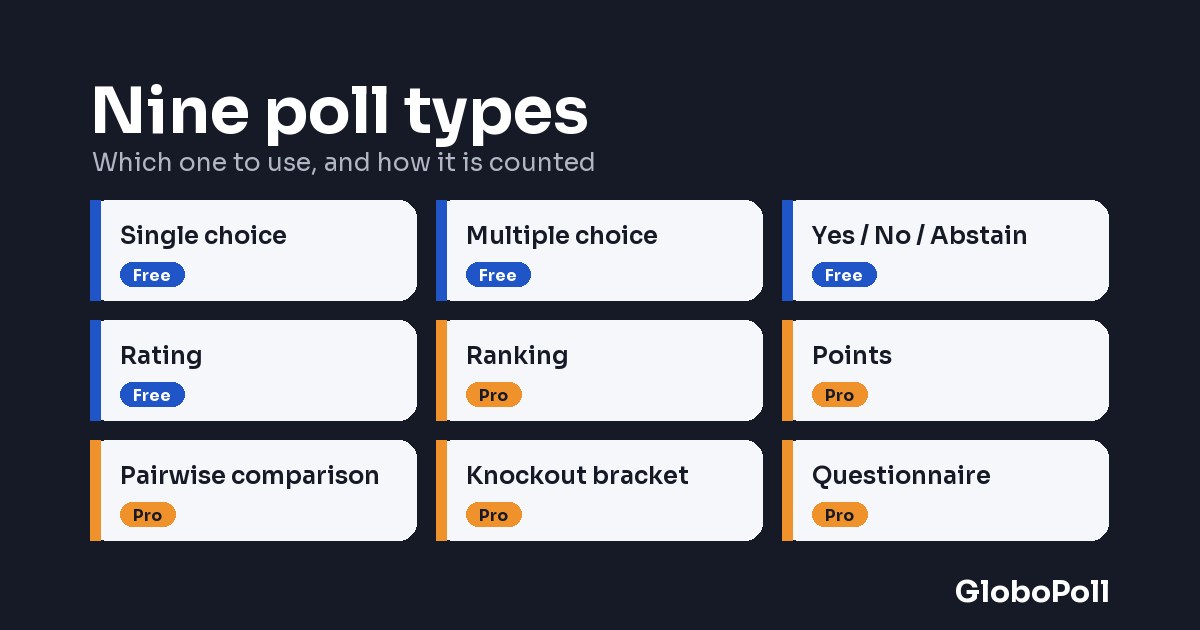
Single choice, multiple choice, yes / no, rating, ranking, points, pairwise, bracket and questionnaire: what each does, how it is counted, when to use it.
· Cibernatural · 8 min read · Updated on 2026-10-11
The decision that changes a poll's result the most is not the question: it is how people answer it. Asking "which poster do you like best?" with a single box gives a winner by simple majority; asking the same thing with a ranking can give a different one, because second preferences count too. Neither is wrong; they serve different purposes.
GloboPoll now has nine poll types. Four are free and cover most cases; five belong to the Pro plan and solve what an ordinary form cannot. This post explains each one the same way: what it is for, how it is counted, and an example.
What stays the same across all of them: one vote per person (per account, or per connection and browser when voting without signing up), live results with the total and the date on every page, the option to hide the breakdown until the poll closes, vote changes if the poll allows them, and a final result that is fixed at closing and can be exported as CSV.
1. Single choice
What it is. One question, several options, one answer per person. The option with the most votes wins.
When to use it. When only one answer fits and no nuance is needed: the date of the party, the team name, the dish of the day. It is the format that works best in a widget on another website, because it is answered with one click.
How it is counted. Votes per option and percentage of all votes. If you want, with an image on each option and an "Other" option with a free answer that only the poll's manager reads.
An example you can vote on right here:
Vote in the poll: «What is your ideal holiday?»
2. Multiple choice
What it is. Each person ticks several options. The poll's creator sets the minimum and maximum; with no maximum it is approval voting: you tick everything you approve of.
When to use it. "Which workshops should we run this term? Pick up to three." Or to find out which channels people use, which days suit them, which topics they want at an event.
How it is counted. Votes per option, but the percentage is over ballots, not over ticks: an option everyone ticks shows 100 %, even if each person also ticked two others. That way the result says how many people support each option, which is what you want to know.
3. Yes / No / Abstain
What it is. A referendum. The two options are fixed, in the poll's language, and there is a third box: abstain.
When to use it. "Do we approve the change to the statutes?" "Do we switch supplier?" Any yes-or-no decision where it also matters who prefers not to take a position.
How it is counted. An abstention uses up the single vote and is added to the total, but percentages are over the votes cast for or against: 60 yes, 30 no and 10 abstentions is 67 % in favour, not 60 %. Abstentions are shown separately.
4. Rating
What it is. No options: each person gives a score. Stars from 1 to 5, a numeric scale (0 to 10, for instance), a slider or an NPS (0 to 10, "how likely are you to recommend us?"), with labels at both ends if needed.
When to use it. Satisfaction after a course, a visit or a service; rating a proposal before discussing it; measuring recommendation with NPS, the scale many companies already use.
How it is counted. Mean, median and distribution of the scores (how many people gave each one). With NPS, the result is the percentage of promoters (9 and 10) minus the percentage of detractors (0 to 6), from −100 to 100, and the three groups are shown.
5. Ranking
What it is. Voters order the options by preference: first, second, third… You can require all options to be ranked or let each person rank only the ones they want. Pro plan.
When to use it. Choosing between five posters, three candidacies or ten proposals when more than first place matters: an option that is almost everyone's second choice can be a better consensus than the one that is first for a third of people.
How it is counted. The method is chosen when the poll is created and cannot change once there are votes:
- Borda count: each position is worth points (with five options, first gets 4, second 3…) and the highest sum wins. It rewards consensus.
- Instant runoff (rounds): first preferences are counted, the option with the fewest is eliminated and its votes move to the next preference on each ballot, until one passes half. Every round is shown in the results.
- Condorcet: options are matched two at a time using what each ballot says; the one that beats all the others wins. If there is none, they are ordered by wins minus losses.
6. Points
What it is. Each person gets a budget of points (ten, say) and spreads it across the options however they like: all on one, a little on several. Pro plan.
When to use it. Participatory budgets, prioritising a list of improvements, splitting a fund between projects. It is the type that best captures intensity: "I like this one" is not the same as "this one matters a lot to me".
How it is counted. The points received are added up. With quadratic voting, giving p points to an option costs p² credits of the budget: concentrating is expensive, so whoever strongly backs one thing pays for it and moderate preferences weigh more. The results show the points, each option's share and how many ballots support it.
7. Pairwise comparison
What it is. No lists: two options are shown and the voter picks the one they prefer. Then another two, and another two, as many duels as they like; you can stop whenever you want and skip a pair. Pro plan.
When to use it. Choosing a logo among twelve proposals, a product name, a campaign photo. Ranking twelve things at once is asking too much; deciding between two is instant, and the ranking emerges on its own.
How it is counted. The server always proposes the pair compared least so far, so no option is left out. The ranking comes from Elo (as in chess: beating a strong option is worth more than beating a weak one) or Copeland (wins minus losses against each rival). Each option's win rate and its duels won and lost are shown.
8. Knockout bracket
What it is. A bracket of 8 or 16 options that face each other in pairs. Each round lasts as many days as you set; when it closes, the winners move on, and so on until the final and the champion. Pro plan.
When to use it. The best local dish, the song of the summer, the player of the season: votes that are followed in instalments, with a new round every week that brings people back.
How it is counted. One vote per person per round; in each duel the most voted option wins (in a tie, the first of the pair, as the editor says). The whole bracket is shown on the poll's page, with past rounds, the current one and those still to come.
9. Questionnaire
What it is. Several questions in one poll, each of its own type: single choice, multiple choice, yes / no, rating, ranking, points or free text. With sections that become pages, matrices (several rows sharing one scale) and questions that appear only depending on earlier answers. Up to ten questions. Pro plan.
When to use it. When you want to know more than one thing at a time: the satisfaction survey after an event, the diagnosis of a service, consulting members before a general meeting.
How it is counted. One single vote per person for the whole questionnaire and one result per question, each with its own count. Text answers are read only by the poll's manager, grouped by keywords; the public sees how many there are. There is a whole post about questionnaires.
And one more structure: the multi-round poll
It is not a tenth kind of ballot but a way to chain the ones above. A closed poll gives way to the next round, of another type, with the proposals its organiser picks: a free-text questionnaire to collect ideas, a points poll to prioritise the ones that go through and a single choice to vote on the final. It is the flow of a participatory budget or a Delphi consultation, and it has its own post. Pro plan.
How to choose, in one table
| You want to know… | Type |
|---|---|
| Which one wins, full stop | Single choice |
| How many people support each option | Multiple choice |
| Whether it is approved or not | Yes / No / Abstain |
| What score people give it | Rating |
| The full order, not just first place | Ranking |
| How much each option matters | Points |
| Which they prefer among many, without fatigue | Pairwise comparison |
| A vote that lasts weeks and keeps people coming back | Knockout bracket |
| Several things at once | Questionnaire |
| A process in several rounds: proposals, prioritisation and vote | Multi-round poll |
If you hesitate between two, pick the simpler one: a single-choice poll answered in ten seconds collects more responses than a perfect ranking people abandon halfway.
What is coming
Still on the plan are the voter census with weighted votes and secret voting with minutes and quorum for councils and associations. Each will get its post when it ships. (Multi-round polls, which were on this list, shipped on 9 October.)
The four free types ask for no card: create a trial poll without an account and watch the results move live. The others are in the Pro plan, and How it works has the full list, including the ones in preparation.
Method guides
Each counting method now has its own guide, with a worked example and sources: Borda count, instant runoff and Condorcet, quadratic voting for participatory budgets and NPS.