GloboPoll blog · Guides
Borda count: what it is and when to use it
What the Borda count is, how to calculate it with four options and ten ballots, when it is the right choice, its weaknesses and where it is used.
· Cibernatural · 5 min read
When people are asked to rank several options instead of ticking one, a rule is needed to turn those rankings into a result. The Borda count is the oldest and the easiest to explain: every position is worth points. This guide walks through a worked example, says when it fits and when it does not, and shows how to use it on GloboPoll.
What is the Borda count?
The Borda count is a ranked voting method: each position on the ballot is worth points, and the option with the highest total wins.
With n options, first place is worth n − 1 points, second place n − 2, and so on down to last place, worth 0. The points from every ballot are added up and the final order is the order of those sums. Jean-Charles de Borda proposed it to the Paris Academy of Sciences in 1781, although Nicholas of Cusa had described an almost identical system in 1433 for electing the emperor.
How is the Borda count calculated?
Points are assigned to each position, the points from all ballots are added up, and the options are sorted from highest to lowest total.
An example with four options (A, B, C and D) and ten ballots. First place is worth 3 points, second 2, third 1 and last 0:
| Ballots | Ranking |
|---|---|
| 4 | A > B > C > D |
| 3 | C > B > D > A |
| 3 | D > B > C > A |
Points per option:
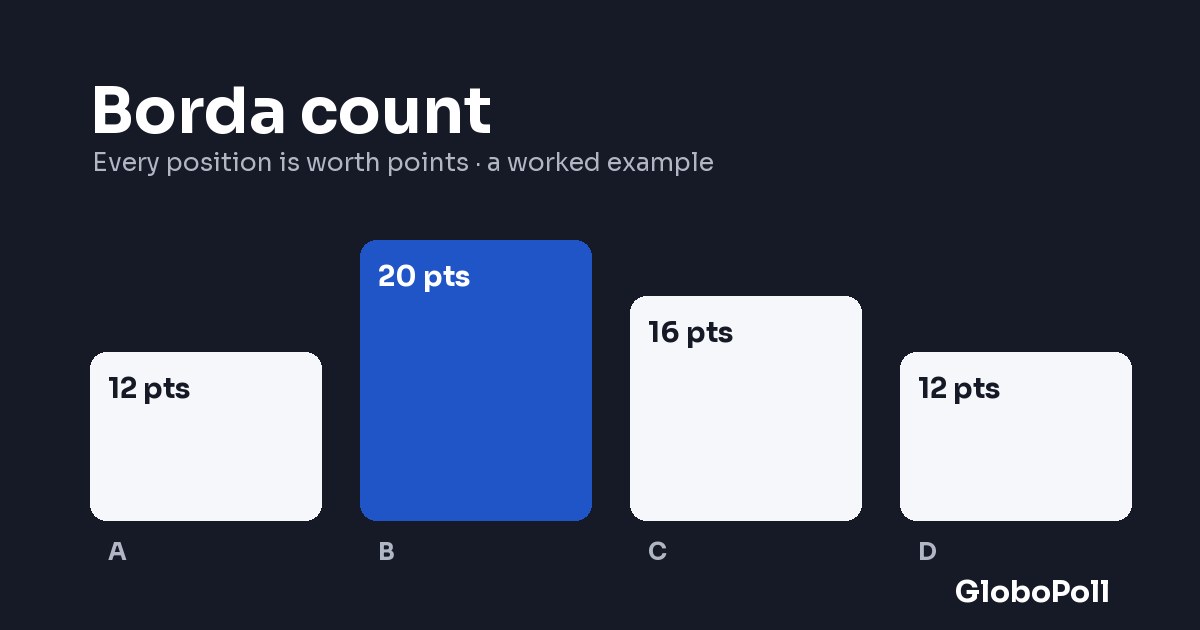
- A: 4 × 3 + 3 × 0 + 3 × 0 = 12
- B: 4 × 2 + 3 × 2 + 3 × 2 = 20
- C: 4 × 1 + 3 × 3 + 3 × 1 = 16
- D: 4 × 0 + 3 × 1 + 3 × 3 = 12
B wins with 20 points. Counting first places only, A would have won with four votes out of ten: a 40 % that leaves the other 60 % with their least preferred option. B is nobody's first choice, but it is everybody's second, and that is exactly what Borda rewards.
When should you use the Borda count?
Use it when you want the option most acceptable to the whole group, not the one a faction is most excited about: consensus decisions, committees, awards.
Typical cases: choosing a poster, a name or a date among several proposals when a relative majority is not enough; awards where a jury ranks candidates; a team's priorities. In all of them, an option that is "everyone's second" is usually a better outcome than one that is "first for a few".
What are the weaknesses of the Borda count?
It is vulnerable to strategic voting: placing the main rival last takes points away, and adding similar options changes the result.
The first is called burying: if I know A and B are the favourites and I prefer A, I can rank B last even though it is really my second choice. Borda himself acknowledged it ("my scheme is intended only for honest men"). The second problem is that the result depends on which options are on the list: adding two variants of A splits its points and can hand the win to another option. That is why Borda works best with short, closed lists, and when voters do not see a running tally. It also does not guarantee that the winner would beat every other option head to head (the Condorcet winner), as explained in Instant runoff and Condorcet.
Where is the Borda count used?
It is used in the Eurovision Song Contest, in the Slovenian parliament, in Nauru and in many sports and cultural awards decided by a jury.
Eurovision has given 12, 10, 8, 7… points to each jury's and each televote's top ten songs since 1975: a positional count from the Borda family. Slovenia elects the two deputies of its Italian and Hungarian minorities by Borda count. Nauru uses a variant (the Dowdall system) in which first place is worth 1, second 1/2, third 1/3… Jury awards that score 5-3-1 or 6-4-3-2-1 by position follow the same logic.
How do you run a Borda poll on GloboPoll?
Create a ranking poll, choose Borda as the counting method and decide whether voters must rank every option.
The ranking type is part of the Pro plan. The method (Borda, instant runoff or Condorcet) is chosen when the poll is created and cannot be changed once there are votes, because changing the count with ballots already cast would be manipulating the result. You can require everyone to rank all options or let each person rank only the ones they want: unranked options are worth 0 points. The results show each option's score and position, with first preferences shown separately so you can see when Borda and a simple majority disagree. On mobile, options are ordered by dragging or with buttons.
All nine types, with when to use each, are in Nine poll types; the Pro plan is on the pricing page.
Sources
- Jean-Charles de Borda, Mémoire sur les élections au scrutin, Histoire de l'Académie royale des sciences, Paris, 1781.
- Kenneth J. Arrow, Social Choice and Individual Values, Wiley, 1951 (no ranked method satisfies every desirable property at once).
- Borda count, Wikipedia, including its use in Slovenia, Nauru and Kiribati.
- How the Eurovision Song Contest voting works, European Broadcasting Union.