GloboPoll blog · Guides
Instant runoff and Condorcet: rounds and duels
How instant-runoff voting (rounds with elimination) and the Condorcet method (duels) work, with an example where each method picks a different winner.
· Cibernatural · 5 min read
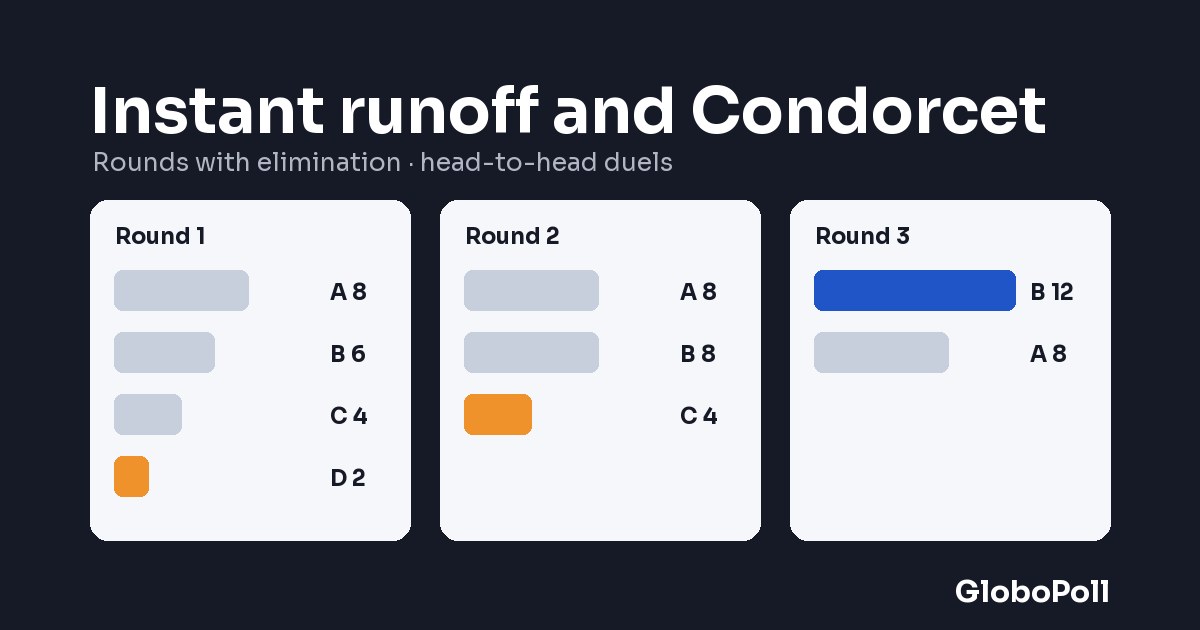
The two most common ways to count a ranked ballot, apart from Borda, are instant-runoff voting and the Condorcet method. Both start from the same ranked ballot and can produce different winners from the same votes. This guide explains them with a twenty-ballot example in which the simple majority, instant runoff and Condorcet each pick a different option.
What is instant-runoff voting?
Instant runoff counts first preferences, eliminates the option with the fewest in each round and transfers its ballots to their next preference until one passes half.
It is also called ranked choice voting or the alternative vote: instead of calling a second election between the top two, every ballot already says where the vote should go if its first choice is eliminated. Thomas Hare described it in 1857, and its current single-winner form is attributed to William Robert Ware in 1871.
How are the rounds counted?
In each round the current first preferences are added up; if no option passes 50 %, the last one is eliminated and its ballots are redistributed.
Twenty ballots and four options:
| Ballots | Ranking |
|---|---|
| 8 | A > C > B > D |
| 6 | B > C > A > D |
| 4 | C > B > A > D |
| 2 | D > B > C > A |
Round 1. First preferences: A 8, B 6, C 4, D 2. Nobody reaches 11. D is eliminated and its two ballots move to their second choice, B.
Round 2. A 8, B 8, C 4. Still no majority. C is eliminated and its four ballots move to B.
Round 3. B 12, A 8. B wins with 60 %.
A simple majority in the first round would have elected A. Instant runoff guarantees that the winner is backed by more than half of the ballots still in play, and GloboPoll's results show every round, who was eliminated and where their votes went.
What is a Condorcet winner?
It is the option that beats every other option in a head-to-head duel, counting on each ballot which of the two is ranked higher.
The Marquis de Condorcet proposed it in 1785. With the same twenty ballots as above:
- C against A: the 6 + 4 + 2 = 12 ballots that rank C above A prefer C; the remaining 8 prefer A. C wins.
- C against B: 8 + 4 = 12 prefer C; 6 + 2 = 8 prefer B. C wins.
- C against D: 18 to 2. C wins.
C beats everyone: it is the Condorcet winner. It was neither the simple-majority winner (A) nor the instant-runoff winner (B). Counted with Borda, C wins too (42 points against B's 38 and A's 34). Three methods, three winners: that is why the method is chosen before the vote opens, not after.
What happens when there is no Condorcet winner?
A can beat B, B beat C and C beat A: that is Condorcet's paradox, and then a tie-breaking rule is needed.
With three ballots A > B > C, B > C > A and C > A > B, every option wins one duel and loses another. GloboPoll then orders by the Copeland method: wins minus losses against every rival; if those are tied too, the options share the position. More elaborate rules exist (Schulze, ranked pairs) that resolve more cycles at the cost of being harder to explain to voters.
Instant runoff or Condorcet?
Instant runoff when the winner needs a majority that can be explained round by round; Condorcet when it matters that nobody beats the winner head to head.
Instant runoff is easier to count by hand and to narrate ("in the third round…"), and it is used in public elections. Condorcet captures consensus better: an option can be eliminated in the early rounds of instant runoff and still be the one almost everyone preferred over any other, like C in the example. Neither is perfect: Kenneth Arrow proved in 1951 that no ranked method satisfies every desirable property at once.
Where are they used?
Instant runoff elects Australia's House of Representatives since 1918, Ireland's president and offices in Maine, Alaska and New York City; Condorcet is used mostly inside organisations.
Australia adopted it in 1918; Ireland has elected its president this way since 1938; in the United States, Maine uses it in federal elections since 2018, Alaska since 2022 and New York City in its municipal primaries since 2021. Condorcet methods are rare in public elections but common in associations and projects: the Debian project elects its leader with the Schulze method, which satisfies the Condorcet criterion.
How do you use them on GloboPoll?
Create a ranking poll and choose instant runoff or Condorcet as the method; the method cannot be changed once there are votes.
The ranking type is part of the Pro plan. With instant runoff, the results show every round in a collapsible list, the eliminated option and the exhausted ballots (those with no further preferences). With Condorcet, the duel matrix, the winner if there is one and the Copeland ordering if there is not. In both cases first preferences are published separately, which is what the embedded widget shows. All nine types are in Nine poll types and the Pro plan is on the pricing page.
Sources
- Nicolas de Condorcet, Essai sur l'application de l'analyse à la probabilité des décisions rendues à la pluralité des voix, Paris, 1785.
- Kenneth J. Arrow, Social Choice and Individual Values, Wiley, 1951.
- Instant-runoff voting and Condorcet method, Wikipedia, with the list of countries that use them.
- Preferential voting, Australian Electoral Commission.
- Debian Constitution, appendix A (Schulze method).