GloboPoll blog · Guides
NPS: what it is, how to calculate it and measure it
What the Net Promoter Score is, how to calculate it with fifty responses, what a good NPS is, the criticism it gets and how to measure it on GloboPoll.
· Cibernatural · 4 min read
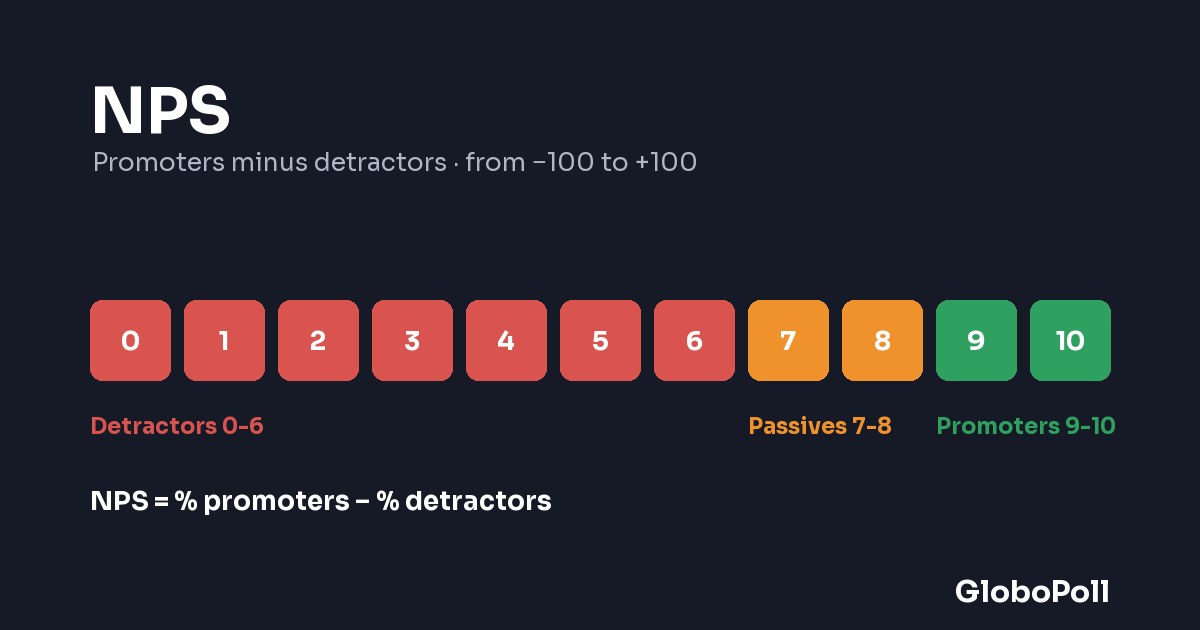
The Net Promoter Score is the most widespread satisfaction metric because it fits in a single question: "How likely are you to recommend us to a friend or colleague?". This guide explains how it is calculated with an example, what counts as a good score, what the studies that tested it hold against it and how to measure it with a poll, for free, on GloboPoll.
What is the NPS?
The NPS is a recommendation metric that subtracts the percentage of detractors from the percentage of promoters on a 0-to-10 scale.
Anyone who answers 9 or 10 is a promoter; 7 or 8, a passive; 0 to 6, a detractor. The NPS runs from −100 (everyone a detractor) to +100 (everyone a promoter). Fred Reichheld proposed it in a 2003 Harvard Business Review article, and it is a registered trademark of Bain & Company, Satmetrix and Reichheld himself.
How is the NPS calculated?
Count the percentage of 9 and 10 answers, subtract the percentage of 0-to-6 answers, and leave the passives out of the subtraction.
An example with fifty responses:
| Group | Scores | Responses | Share |
|---|---|---|---|
| Promoters | 9-10 | 25 | 50 % |
| Passives | 7-8 | 15 | 30 % |
| Detractors | 0-6 | 10 | 20 % |
NPS = 50 − 20 = 30. Note that it is not an average: an 8 and a 0 weigh the same as a 7 and a 6. That is why two companies with the same mean score can have very different NPS values, and why the distribution is worth looking at too.
What is a good NPS?
Anything above 0 means more promoters than detractors; above 50 is considered excellent, although the meaningful benchmark is your own sector.
Bain, which created the method, describes an NPS above 0 as "good", above 20 as "favourable", above 50 as "excellent" and above 80 as "world class". Airlines, telecoms and insurers usually sit in low numbers; specialist retail and some technology brands, in high ones. What matters is not the number on its own but how it compares with the sector and, above all, with your own NPS from previous months.
When and how do you ask?
Right after the experience you want to measure, with a single 0-to-10 question and a second, open question: "why?".
The open question is what turns the number into something you can act on: promoters say what to keep and detractors what to fix. Ask the same way every time (same wording, same scale, same moment) so the series stays comparable, and do not overdo it: a survey after every contact wears people out until only the very happy and the very angry answer.
What does the NPS not measure?
It does not measure satisfaction with any specific aspect, it does not predict growth on its own, and it depends heavily on who chooses to answer.
Reichheld presented the NPS as "the one number you need to grow", but a 2007 study in the Journal of Marketing did not find it predicted growth better than other satisfaction metrics. Scores also shift with culture: in some countries an 8 is a high mark and in others it is not. The NPS is a cheap thermometer that is comparable over time, not a diagnosis; the diagnosis is in the open answers.
How do you measure the NPS with GloboPoll?
Create a rating poll with the NPS presentation; the scale is fixed from 0 to 10 and the results already show the NPS with its sign.
The rating type is free. When you pick the NPS presentation, the scale runs from 0 to 10 with "Not at all likely" and "Extremely likely" at the ends (both editable), and the results show the NPS, the split of promoters, passives and detractors as a bar, plus the mean and median in case you need them. To add the "why?", use a questionnaire (Pro plan) with the NPS question and a free-text question whose answers only the poll's managers can read, grouped by keyword. The poll can be embedded on your site or sent as a link, and single-use invitations guarantee one answer per customer. All nine types are in Nine poll types; create a trial poll without an account to see how it looks.
Sources
- Frederick F. Reichheld, "The One Number You Need to Grow", Harvard Business Review, December 2003.
- Timothy L. Keiningham, Bruce Cooil, Tor Wallin Andreassen and Lerzan Aksoy, "A Longitudinal Examination of Net Promoter and Firm Revenue Growth", Journal of Marketing, vol. 71, no. 3, 2007.
- Net Promoter System: Measuring Your Net Promoter Score, Bain & Company (definition and thresholds).
- Net promoter score, Wikipedia.