GloboPoll blog · News
Multi-round polls: from proposals to the final vote
Chain rounds of different types: text proposals, prioritisation by points and a final vote. Each round is born from the previous result.
· Cibernatural · 4 min read
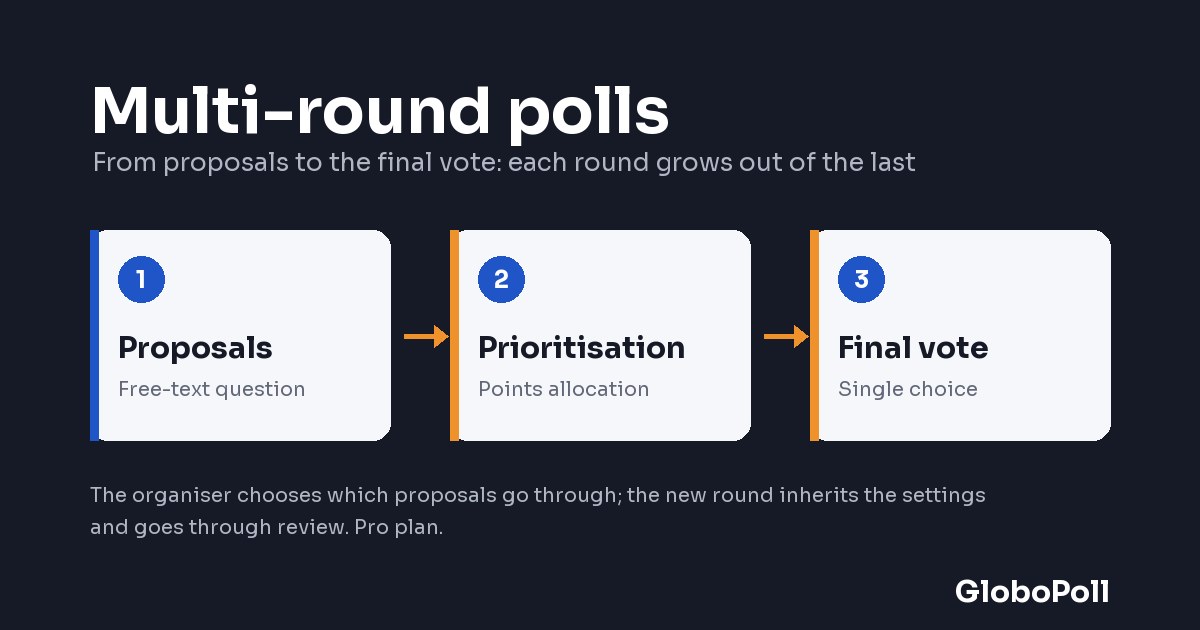
A participatory budget has three moments that look nothing alike: first people propose ("what would we do with 50,000 euros in the neighbourhood?"), then what came in is prioritised (a hundred ideas do not fit on one ballot) and finally there is a vote between the few that remain. Until now on GloboPoll that meant three separate polls nobody connected. From today it is one multi-round poll: the next round is created from the result of the previous one, and voters see the whole process.
It is the same flow as a Delphi consultation: several passes in which what the group said in one feeds the next. And it is, on purpose, the opposite of a knockout bracket: there the rounds generate themselves when one closes; here a person decides them.
How it works
Round 1: proposals. A questionnaire with one free-text question: "What project do you propose for the neighbourhood?". It is published, people write, it closes.
The step between rounds. With the poll closed, the Results tab of the dashboard shows "Next round" with everything that could go through: the written proposals, grouped when several people propose the same thing ("Playground · 7 people proposed it", even if some wrote it in capitals and others with an extra space), or the options with their result if the previous round had options. Each proposal has a checkbox and an editable text: you tick the ones that go through, shorten a three-line proposal into a title, merge two similar ones, add one nobody wrote but that sums up what several asked for. You choose the type of the new round, a title and, the first time, the name of the series ("Participatory budget 2027"). One button creates the next round as a draft.
Round 2: prioritisation. The new round is a points poll (or a ranking, a single choice or a multiple choice: you choose) with the chosen proposals as options. It inherits the voting settings of the previous one: who can vote, whether comments are allowed, whether results show live or at close, the websites it can be embedded in. You review it in the editor, submit it for review and publish it like any poll. When it closes, the same step again.
Round 3: final vote. A single choice between the three or four that gathered the most points. And there it ends, or not: a series has no fixed number of rounds.
Why the step is manual
A bracket can advance on its own because the rule is clear: whoever has more votes goes through. In a proposals process, what moves from one round to the next is an editorial decision: there are duplicate proposals, unfeasible ones, two that are the same idea said two ways. Automating it would mean making that decision badly and out of sight. So GloboPoll prepares the work (groups, orders by result, leaves the texts ready to edit) and the person decides. What people wrote is also content nobody has reviewed: the new round goes through moderation like any other.
Two limits, also on purpose: the next round is created once the previous one has closed (it starts from its final result, not from a half-finished count) and each round has one next round only. If the draft does not convince, delete it and create it again.
What voters see
On each round's page, "Round 2 of 3 · Participatory budget 2027" and the list of rounds, each with its type, status and votes; earlier rounds can be consulted. Someone who lands on a closed round through a link reads, at the top, "The next round is now open" with the button to go and vote. The widget embedded on the council's or the association's website follows the series: it always shows the most recent public round, without touching the code. And anyone voting with an account can ask, after voting, for an email when the next round is published.
What does not change is the usual: one vote per person and round, live results, a final result fixed at close.
How to start
Any closed poll can be the first round, including one you already have: open Results and look for "Next round". Multi-round polls are part of the Pro plan; seeing what would go through to the next round costs nothing. If you want the full participatory-budget flow, start with a questionnaire with one text question: it is the format that collects the most proposals. How it works lists every poll type, this one included.